


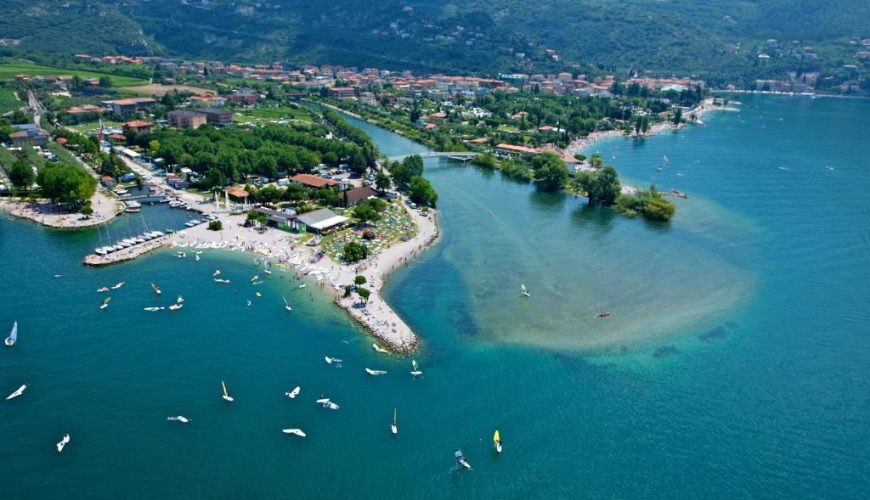
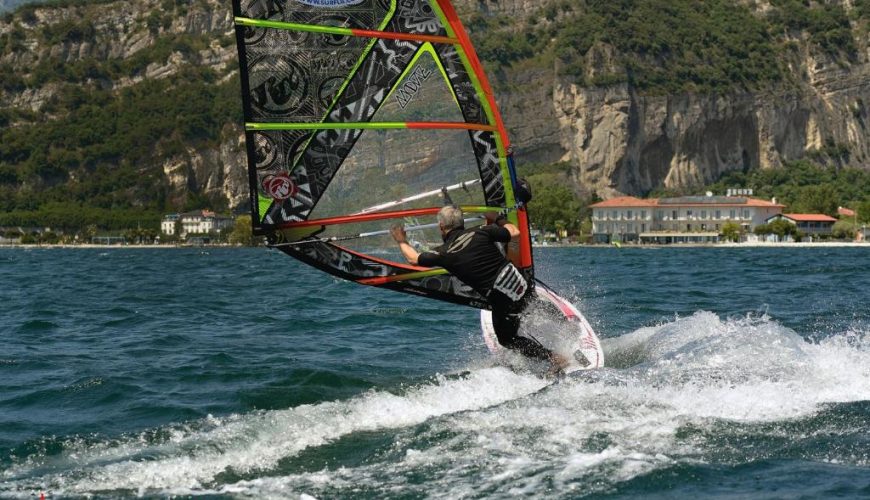
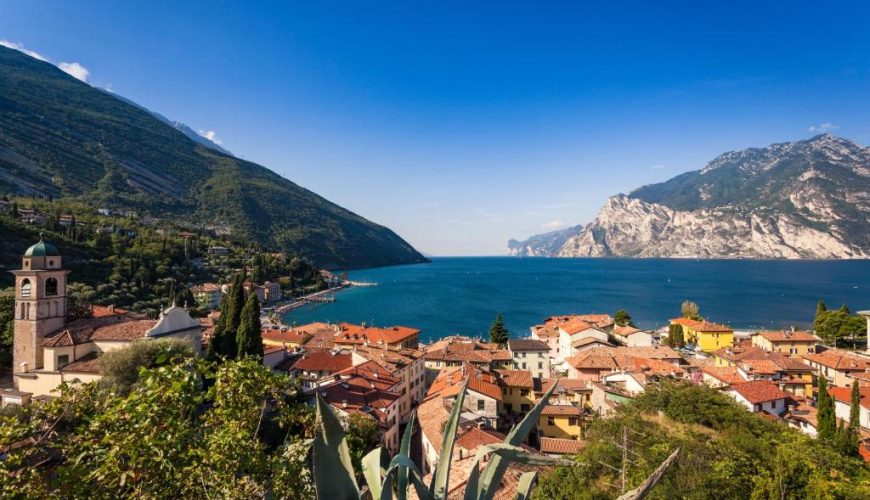

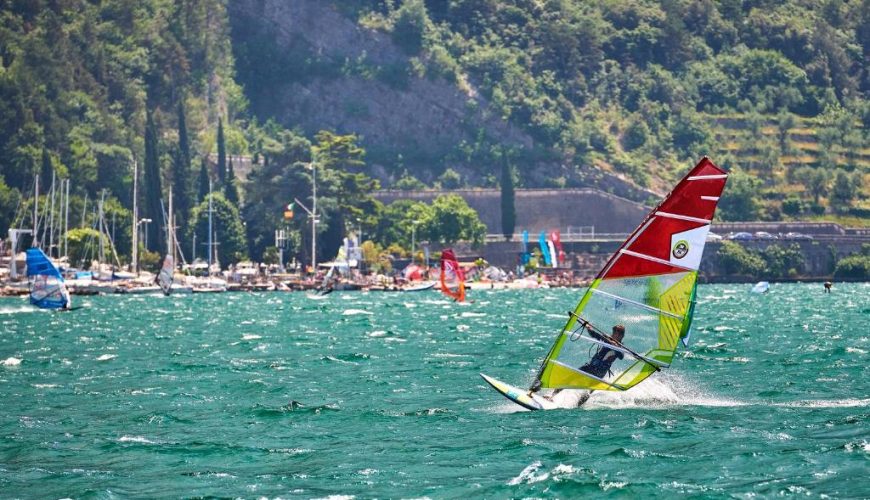

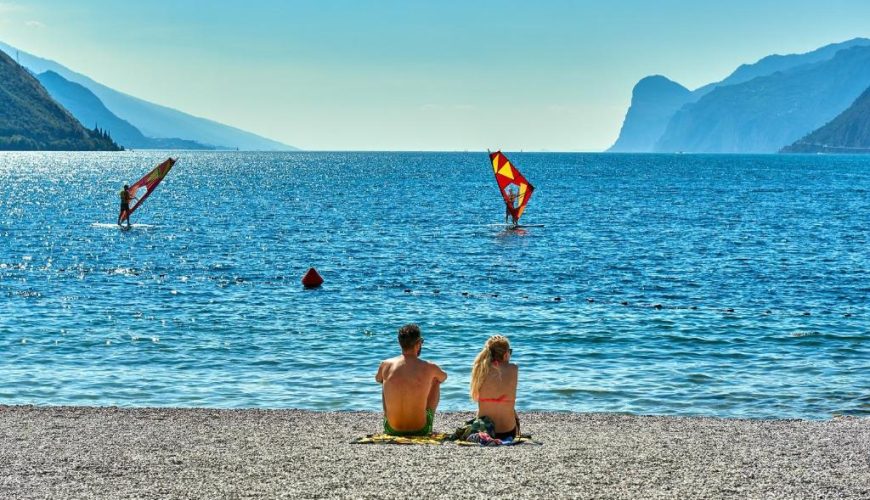
Lake Garda is considered one of the best windsurfing destinations in Europe, attracting thousands of surfers from around the world every year. The combination of reliable winds, Mediterranean climate, and stunning mountain scenery makes Italy’s largest lake a paradise for windsurfers of all skill levels. Whether you’re stepping onto a board for the first time or you’ve been riding waves for years, Lake Garda offers perfect conditions for everyone.
Why Lake Garda is Perfect for Windsurfing
Lake Garda offers ideal conditions for windsurfing that are rare to find elsewhere in Europe. Two thermal winds dominate the action on the water, providing reliable conditions almost year-round.
The Legendary Winds: Ora and Peler
Lake Garda is characterized by two distinctive thermal winds that attract windsurfers from across Europe. These winds are so reliable that Lake Garda became one of the world’s first windsurfing hotspots back in the 1970s.
The Peler – The Gentle Morning Breeze
The Peler blows in the early morning hours from the north, traveling from the northern shore southward across the lake. This wind is created by the nighttime cooling of the mountains in the north, particularly Monte Baldo. When cold air flows down from the mountains to the lake, it creates a consistent and predictable north wind.
The Peler typically starts between 3 and 6 AM and lasts until about 9 or 10 AM. Wind strength usually ranges between Force 2-4 on the Beaufort scale, though it can reach Force 5 on particularly good days. The Peler’s strength depends heavily on weather conditions – after clear, cool nights it’s especially pronounced.
For beginners, the Peler is perfect: the wind is consistent, not too strong, and the gusts are moderate. Experienced surfers also appreciate the morning hours for relaxed cruising sessions or practicing new maneuvers. The peaceful atmosphere in the early morning, when the lake is still empty and the sun is just rising over the mountains, has a special magic.
The Ora – The Powerful Afternoon Wind
The Ora is the star among Lake Garda’s winds and the reason why so many windsurfers make the pilgrimage here. This south wind blows from late morning until early evening. The Ora is created by the warming of the Po Valley south of the lake. Rising warm air over the mainland is replaced by cooler air from the lake, creating a strong and consistent south wind.
The Ora typically sets in between 11 AM and 1 PM – sometimes gently, sometimes very abruptly. Experienced surfers recognize the Ora’s arrival by the first small waves on the water and the cirrus clouds forming over the southern mountains. Within 30 minutes, the wind can increase from calm to Force 5-6 on the Beaufort scale.
On good days, the Ora reaches wind strengths of Force 5-6, and on peak days even Force 7. The Ora is particularly strong and reliable during summer months. In high summer (July and August), it blows on about 80-90% of all days – an exceptionally high rate for thermal winds.
However, the Ora is not an easy wind. It can be gusty, especially on the northern shore between Torbole and Riva. Katabatic winds from the mountains amplify the Ora in some places, creating turbulent conditions. For advanced surfers, this is perfect – high speeds, spectacular jumps, and powerful maneuvers are possible.
Wind Forecasting at Lake Garda
The reliability of thermal winds makes Lake Garda particularly attractive. Unlike many other spots where you have to hope for the right weather conditions, the thermal system at Lake Garda works almost guaranteed. With beautiful, sunny weather and stable high-pressure systems, Peler and Ora are virtually certain.
However, there are also windless days – for instance, during bad weather, heavy cloud cover, or when large-scale wind systems disrupt local thermal activity. On average, these represent only about 10-20% of days during the main season.
Various wind forecast apps and websites exist for Lake Garda. Particularly popular are Windfinder, Windguru, and local webcams that provide a view of current conditions. Many surf schools and rental stations also offer a daily wind briefing service.
The Best Spots for Windsurfing at Lake Garda
Lake Garda offers various spots that differ significantly in their characteristics. While the northern shore is more suitable for advanced surfers, beginners find ideal learning conditions on the eastern shore. Each spot has its own character and special features.
Torbole – The Mecca of Windsurfing
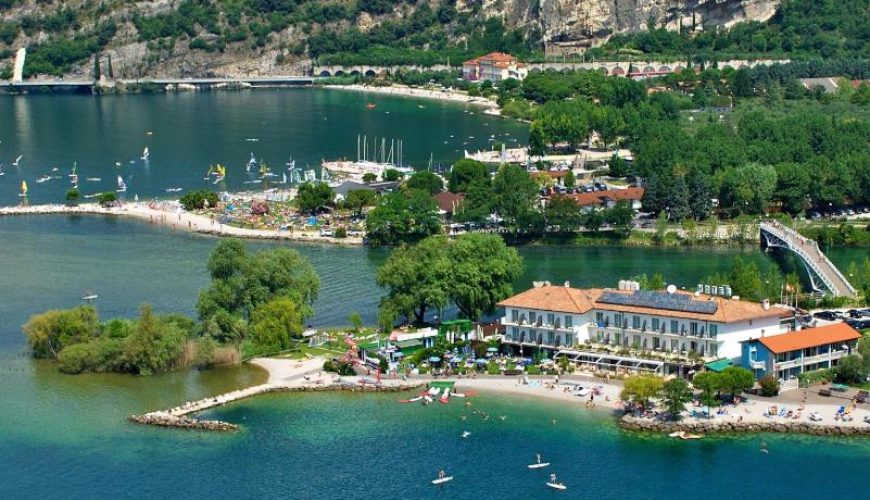
Torbole on the northern shore is considered the most famous and legendary windsurfing spot at Lake Garda. Here the Ora hits the lake with full force, creating spectacular conditions. Torbole has been synonymous with windsurfing since the 1970s and has significantly shaped the sport’s development.
Wind Conditions in Torbole
The Ora comes from the south directly toward Torbole and is channeled by the surrounding mountains. This creates particularly strong and consistent wind conditions. On good days, wind speeds of 25-35 knots are common. The thermal system often sets in very abruptly – within a few minutes the wind can switch from weak to strong.
However, the spot is challenging: the winds can be gusty as katabatic winds from the surrounding mountains amplify the Ora. Turbulence is especially common near the shore. Advanced surfers love these conditions, but beginners can quickly become overwhelmed.
Different Areas in Torbole
Torbole can be divided into several areas. The main beach “Spiaggia Conca d’Oro” is the central launch point with a sandy bottom and good infrastructure. Most surfers start and land here. With strong Ora, however, it can get very crowded – up to 200 surfers share the spot simultaneously.
Slightly to the north lies “Foce Sarca,” the mouth of the Sarca River. This area is somewhat quieter and also offers good conditions with north wind (Peler). The bottom here is rocky, so water shoes are recommended.
Infrastructure and Surf Schools
The infrastructure in Torbole is perfectly developed. Surf schools, rental stations, shops, and cafés line the waterfront promenade. Among the best-known surf schools are Vasco Renna, Surf Segnana, and Surf & Sail School Torbole. All offer courses for different levels, the latest equipment, and German-speaking instructors.
The vibrant surf scene creates a special atmosphere. In the evenings, surfers gather in bars and restaurants to review the day and plan the next session. Torbole has developed its own surf culture rarely found at other spots.
Tips for Torbole
Getting up early pays off! Those who use the morning hours with the Peler often have the spot almost to themselves. In the afternoons with the Ora it can get very crowded – experienced surfers head farther out where there’s more space.
The parking situation in Torbole is difficult. Especially in summer, parking lots are overcrowded. Those who come by bike or on foot save themselves stress and parking fees.
Riva del Garda – Windsurfing between Mountains and Waves
Directly west of Torbole, only about 3 kilometers away, lies Riva del Garda. The town offers similar wind conditions to Torbole but is less well-known and therefore somewhat less crowded. Riva is an attractive alternative when Torbole is too busy.
The Spots in Riva
There are several launch points in Riva. The main spot is at “Porfina Beach” in the north of the town. Here the entry is wide and comfortable, the water is deep enough to launch without problems even at low water. Wind conditions are similar to Torbole – the Ora blows with full force but can be somewhat less gusty.
Another popular launch point is at “Spiaggia Sabbioni” slightly south of the center. This area is particularly good with south to southeast winds and offers somewhat more space than Porfina Beach.
Waves and Conditions
Especially on windy days, small to medium-sized waves can develop in Riva. These aren’t comparable to real ocean waves but offer enough action for freestylers and wave enthusiasts. The waves form particularly with sustained strong Ora and can reach heights of 0.5 to 1 meter.
The Town of Riva del Garda
Riva itself is a beautiful town with a historic center, Venetian architecture, and vibrant atmosphere. The old town with its narrow alleys, plazas, and arcades invites strolling. Riva offers more charm and culture than the touristy Torbole.
Infrastructure for windsurfers is also excellent. Several surf schools and rental stations, including the renowned Vasco Renna Surfcenter branch, offer their services. Prices tend to be slightly cheaper than in Torbole.
Malcesine – Windsurfing perfect for Beginners
The picturesque Malcesine on the eastern shore is the ideal spot for windsurfing beginners and those who prefer it more relaxed. The Ora arrives here from the southwest across the lake and is somewhat attenuated by the distance. This creates moderate and consistent wind conditions without the extreme gusts of the northern shore.
Ideal Learning Conditions
Malcesine offers perfect conditions for learning to windsurf. The entry is shallow and the bottom is sandy or pebbly. The water is crystal clear, so you can see the bottom even near the shore. Wind strengths typically range between Force 3-5 – perfect for first attempts on the board.
The Ora sets in somewhat later in Malcesine than in Torbole, but more gently and without abrupt jumps. This gives beginners more time to adjust to the conditions. The thermal system is also more consistent and less gusty.
Surf Schools and Offerings
Several surf schools specialize in beginners. Malcesine Surf School and Surf Center Malcesine offer excellent beginner courses with modern equipment and patient instructors. Groups are small, so each student gets enough attention.
There are also special courses for advanced surfers – for waterstart, power jibe, or first jumps. The relaxed atmosphere and lower frequency compared to Torbole are additional advantages.
The Town of Malcesine
Malcesine itself is a picture-book town with medieval flair. The Scaliger Castle towers over the town and offers fantastic views over the lake. The narrow alleys, small squares, and rustic restaurants exude Italian charm.
From Malcesine, a cable car leads up Monte Baldo, the 2,000-meter high local mountain. The view from the top is breathtaking and on windless days a welcome alternative to surfing.
Campione – Windsurfing Insider Tip on the West Shore
Campione is located on the western shore of Lake Garda, about halfway between the north and south shores. The spot is very popular with locals but still unknown to many Garda visitors. This makes Campione an insider tip for those wanting to escape the masses.
The Venturi Effect
Campione benefits from a special venturi effect created by the surrounding mountains. The Ora is compressed and accelerated as it flows through narrow valleys. The result is strong, consistent, and very reliable wind conditions. With good Ora, it often blows strongest here of anywhere on the lake.
The wind comes from south to southwest and is usually sideshore to slightly onshore. The gustiness is more moderate than in Torbole, making Campione attractive for advanced intermediates as well.
Conditions and Special Features
With strong Ora, considerable waves can form in Campione – sometimes higher than in Riva. This makes the spot particularly interesting for wave surfers and freestylers. The waves are short but offer enough power for jumps and maneuvers.
The entry is simple, though the water gets deep quickly. A confident waterstart should be mastered. Infrastructure is manageable – there’s a surf rental and a small bar, but no large surf schools.
Getting There and Access
Campione is located on the Gardesana Occidentale, the road running along the western shore. The drive is spectacular but winding. The spot isn’t as prominently signposted as Torbole or Riva – watch for small signs. Parking is available directly at the spot.
Additional Windsurfing Spots at Lake Garda
Besides the main spots, there are other locations on the lake used for windsurfing:
Navene (north of Malcesine): Quiet spot with good beginner conditions, less crowded.
Brenzone (east shore): Several small bays with moderate wind conditions, ideal for relaxed sessions.
Limone sul Garda (west shore): Picturesque town with acceptable wind conditions when the Ora is good, but less consistent than Campione.
Pai di Sopra (south of Torbole): Used with strong Peler when the north wind works particularly well here.
The Best Time for Windsurfing at Lake Garda
Basically, you can windsurf at Lake Garda from April to October, with individual hardy surfers also going on the water in winter. Thermal winds function particularly reliably during summer months, but spring and autumn also have their advantages. Each season at Lake Garda has its own character.
Spring (April to May) – The Insider Tip
Spring is a fantastic but often underestimated time to visit Lake Garda. The thermal system begins working in April and is usually very reliable from mid-April onward. The Ora develops week by week with increasing solar radiation.
Advantages of Spring:
The spots are significantly emptier than in summer. In Torbole, often only 30-50 surfers share the spot instead of 200 in high summer. There’s more space, more freedom, and better focus on your skills.
Temperatures are pleasant – daytime usually between 18-25°C (64-77°F). Summer heat is still absent, which is comfortable when exercising. Nature awakens, everything blooms, and the landscape shows itself in fresh green.
Prices are lower. Accommodation, equipment rental, and surf courses often cost 20-30% less than in high season. The booking situation is also more relaxed – spontaneous trips are easily possible.
Disadvantages of Spring:
Water temperature is still cool. In April it’s about 12-15°C (54-59°F), in May 15-18°C (59-64°F). A 4/3mm or 5/4mm wetsuit is mandatory, many surfers also wear neoprene shoes and gloves.
The thermal system isn’t as strongly developed as in summer. The Ora usually reaches Force 4-5, rarely more. For beginners this is perfect, but power freeriders might miss the extreme sessions of summer.
Some infrastructure is still closed. Some bars, restaurants, and smaller surf schools don’t open until May. The main providers are already active though.
Best Spots in Spring:
Malcesine and the eastern shore are particularly recommended in spring. The moderate wind conditions fit the season perfectly. Torbole also works well but can still be very fresh with cold north winds in the morning.
Summer (June to August) – Peak Season
Summer is the classic windsurfing season at Lake Garda. Conditions are now at their best, but frequency is also at its highest.
June – The Perfect Month:
Many experienced Lake Garda surfers swear by June as the best month. The thermal system is already fully developed and very reliable. The Ora blows on 80-90% of days with decent strength. At the same time, Italian school holidays haven’t started yet, so spots aren’t overcrowded.
Water temperature rises to pleasant 20-22°C (68-72°F). A shorty or thin wetsuit (3/2mm) suffices, many surfers already wear only boardshorts and lycra shirts. Air temperature is around 25-28°C (77-82°F) – warm but not too hot yet.
All infrastructure is open and running at full capacity. All surf schools, rental stations, shops, and restaurants are operating. The atmosphere is lively without being overcrowded.
July and August – Power and Party:
The high summer months are the busiest but also the windiest. The Ora now regularly reaches Force 5-6, on peak days even Force 7. For advanced surfers, this is the best time – fast speeds, high jumps, and powerful sessions are guaranteed.
Water temperature rises to 24-26°C (75-79°F). Neoprene is no longer necessary, boardshorts and rashguard are sufficient. Air temperature can also reach 35°C (95°F) – perfect for a jump into cool water.
However, spots are now at maximum capacity. In Torbole it can get very tight in the afternoons. Patient surfers wait for gaps, aggressive riders take their space. Collisions are possible, caution is advised.
The evening atmosphere in summer is legendary. After surf sessions, everyone sits in beach bars, drinks Aperol Spritz, and lets the day wind down. Nightlife in Torbole and Riva is lively, with parties lasting late into the night.
Tips for Summer:
Book early! Good accommodations are often fully booked months in advance. Those arriving spontaneously must expect high prices or long commutes.
Use early morning hours! With the Peler between 6-9 AM it’s still empty and pleasantly cool. Those who only surf in the afternoon miss half the fun.
Don’t forget sun and heat protection! The sun is strong, sunburn comes quickly. Water-resistant sunscreen with high SPF is mandatory. A hat for breaks is also sensible.
Autumn (September to October) – Golden Autumn
Autumn is a wonderful time to travel that many surfers haven’t discovered yet. Conditions are often just as good as in summer, but the atmosphere is more relaxed.
September – Extended Summer:
September often still feels like summer. The thermal system works excellently, the Ora blows most days with good strength. Water temperature is still 22-24°C (72-75°F) – pleasantly warm.
Italian school holidays are over, many families with children have left. Spots empty out significantly. In Torbole there’s space again, the mood becomes calmer and more focused.
Prices drop back to pre-season levels. Spontaneous bookings are possible again. All infrastructure is still fully active.
October – Golden Autumn:
October shows Lake Garda at its most picturesque. Leaves change color, mountains glow in autumn colors. The air is clear, visibility often better than in summer.
The thermal system still functions reliably until about mid-October. After that it becomes increasingly unstable. The Ora is weaker than in summer, but still sufficient for enjoyable sessions.
Water temperature drops to 18-20°C (64-68°F). A thin wetsuit (3/2mm) is appropriate again. Air temperature is pleasant 18-22°C (64-72°F) – cool enough not to sweat, warm enough for comfort.
Peace returns to Lake Garda in October. Spots are empty, towns relaxed. Those seeking the contemplative side of windsurfing are in the right place now. Many regulars deliberately come in October to enjoy the special atmosphere.
Autumn Tips:
Flexible travel planning! Weather can be changeable in autumn. Those who can flexibly shift a few days will catch the best windows.
Warm clothing for after surfing! Evenings can get fresh. A light jacket or sweater should be packed.
Plan alternative activities! On windless days, hiking, mountain bike tours, or city visits are options.
Winter (November to March) – For the Hardy
In winter, only a few die-hards surf at Lake Garda. The thermal system barely functions anymore as the temperature difference between day and night is too small. On a few days with high pressure weather and strong sunshine, a weak Ora can develop.
Water temperature drops to 8-12°C (46-54°F), a thick wetsuit (5/4mm or 6/5mm) with hood, gloves, and booties is necessary. Most surf schools and rental stations are closed.
For normal windsurfing vacations, winter isn’t suitable. But those living locally or already at the lake anyway can get on the water on individual days.
Windsurfing Courses and Schools at Lake Garda – From Beginner to Pro
For beginners, Lake Garda offers a large selection of professional surf schools with decades of experience. The region was one of Europe’s first windsurfing destinations, and this long tradition is reflected in the schools’ quality. Whether you’re stepping on a board for the first time or want to refine your technique – at Lake Garda you’ll find the right offering.
Beginner Courses – First Steps on the Water
A typical beginner course lasts 3-5 days and teaches all windsurfing basics. Courses are didactically well-structured and follow proven learning methods.
Day 1: Theory and First Practice
The first day usually begins with a theoretical introduction. Participants learn wind theory: Where does wind come from? How do you recognize wind direction? What is Beaufort? Safety rules are also discussed in detail.
Then it’s on to equipment. Surf instructors explain the board’s structure, the rig’s function, how to properly hold the sail, and how to pull it up. These basics are first practiced on land before going on the water.
First water time is spent in waist-deep water. Students learn how to pull the sail from the water, how to maintain balance on the board, and what the basic stance looks like. Most manage to sail a few meters already on the first day.
Day 2-3: Sailing and Steering
On following days, sailing technique is refined. Participants learn how to accelerate, how to steer properly, and how to stop. The tack – turning the board with the nose through the wind – is intensively practiced.
Courses usually take place mornings with gentle Peler or afternoons with light Ora. Instructors stay nearby, give tips, and help with problems. Modern radios or megaphones facilitate communication on the water.
Day 4-5: Jibe and Free Sailing
Advanced beginners learn the jibe – turning the board with the tail through the wind. This technique is more demanding than the tack but essential for relaxed cruising.
By course end, most participants can sail independently, tack, and execute simple jibes. They understand windsurfing’s basic principles and can handle equipment safely.
Costs and Organization
A typical 3-5 day beginner course costs between €150-280, depending on school, season, and group size. Included in the price:
- Equipment use during the course (board, rig, wetsuit)
- Instruction by certified teachers
- Theoretical units
- Often also a logbook or handbook
Group size is usually between 4-8 participants per instructor. Some schools also offer semi-private lessons (2-3 people) or individual instruction, which is more effective but also more expensive.
The Best Surf Schools at Lake Garda
Lake Garda has dozens of surf schools, but some stand out through quality, experience, and service:
Vasco Renna Windsurfing Center (Torbole & Riva)
The Vasco Renna surf school is an institution at Lake Garda. Vasco Renna himself has been surfing since the 1970s and is among the sport’s pioneers at Lake Garda. His schools in Torbole and Riva are considered the most professional on the lake.
Equipment is first-class: modern boards from Starboard and Fanatic, current sails from North, Severne, and Gaastra. There’s suitable equipment for every skill level. Instructors are experienced, patient, and speak multiple languages, including fluent German and English.
Vasco Renna offers courses for all levels: from absolute beginner to pro working on freestyle technique. Special kids courses and family offerings are also in the program.
Surf Segnana (Torbole)
Surf Segnana is one of Lake Garda’s oldest surf schools and is run in the second generation. The school is located directly on Torbole’s main beach and has a large equipment selection.
The family atmosphere is particularly appreciated. Groups are small, instruction individual. Many regulars have been returning to Surf Segnana for years. Prices are moderate, quality high.
Circolo Surf Torbole
Circolo Surf Torbole is a surf club with school operations. The special feature: members get discounted courses and equipment rental. For regulars who come every year, this pays off.
The school has a good reputation for advanced courses. Here intermediates learn waterstart, power jibe, or first freestyle moves. Speed surfing and GPS tracking are also offered.
Malcesine Surf School & Surf Center Malcesine
The two largest schools in Malcesine specialize in beginners. The calmer conditions on the eastern shore are ideal for learning. Schools work with modern beginner equipment – large, stable boards and small, light sails.
Many families appreciate Malcesine as a learning spot. While children are in courses, parents can relax on the beach or take a course themselves.
Advanced Courses – Improving Technique
Those who master the basics want to develop further. Advanced courses focus on specific techniques and maneuvers.
Waterstart Courses
The waterstart is the ultimate skill for advanced surfers. With this technique, you start from deep water without standing on the board. This is essential when wanting to surf on smaller boards or go out in strong wind.
Waterstart courses usually last 1-2 days. Instructors explain body position, timing, and sail handling. With patience and practice, most participants manage to learn the waterstart.
Jibe and Tack Refinement
The power jibe – smooth, fast turning on the planing board – is demanding. Special jibe courses analyze movement sequences, correct errors, and perfect the technique.
The tack can also be refined. Advanced surfers learn the fast tack where the board barely slows down.
Freestyle and Jumps
Those who like it spectacular take a freestyle course. Here you learn first jumps, rotations, and tricks. Instructors at Lake Garda have often competed in contests themselves and can give valuable tips.
Freestyle courses usually take place with strong Ora when there’s enough wind for jumps. Prerequisites are confident waterstart and good basic technique.
Equipment Advice and Rig Tuning
Many schools also offer equipment advice. Which board suits me? What sail size do I need? How do I optimally trim my rig? Such questions are answered in special workshops.
Private Lessons and Coaching
Those wanting to progress quickly or having specific issues book private instruction. A private surf instructor focuses entirely on one student, can individually address strengths and weaknesses, and tailor the instruction.
Private lessons cost about €60-100 per hour, depending on school and instructor. Semi-private lessons (2 people) are cheaper and ideal for couples or friends.
Video coaching is also possible at some schools. The instructor films the student while surfing and then analyzes the footage. This method reveals errors you don’t notice yourself.
Children and Youth Courses
Many schools have special courses for children from about 7-8 years old. Courses are playfully structured and adapted to children’s shorter attention spans.
Equipment is specially designed for children: lightweight boards with lots of buoyancy, small sails that aren’t too heavy to handle. Instructors have experience with children and manage to combine fun and learning.
Teenagers (from about 12 years) can usually participate in regular adult courses or attend teen groups. Lake Garda also has surf camps for teenagers with accommodation, meals, and supervision.
Equipment and Gear – What You Need for Windsurfing
Most surfers at Lake Garda rent equipment on-site. This has many advantages: no transport, no storage, always current equipment, and the ability to try different setups. Lake Garda’s rental stations are excellently equipped and offer equipment for all skill levels and wind conditions.
Renting Equipment at Lake Garda
Prices and Conditions
A complete windsurfing setup (board, sail, mast, boom, mast foot) costs about €50-80 per day depending on season and rental station. For a half day (about 4 hours), €35-50 is typically charged.
With longer rental periods, there are significant discounts. A week pass costs about €250-400, a two-week pass €400-650. Those staying a whole month often pay only double a week pass.
Many rental stations offer subscription systems or multiple-use cards. Regulars often get special conditions. It’s worth inquiring in advance or booking online – there are often early bird discounts.
What’s Included in the Rental Price?
The standard price includes board, rig (sail, mast, boom), and mast foot. Wetsuits, harnesses, and neoprene shoes can often be rented for an additional fee (€5-10/day).
Most rental stations allow unlimited equipment changes during the rental period. This means: you can start in the morning with a large setup for the Peler and switch in the afternoon to a smaller, faster setup for the Ora. Equipment is also exchanged immediately at no cost in case of defects.
Deposit and Insurance
A deposit of €50-200 is common, usually as cash or credit card imprint. The deposit is refunded when equipment is returned undamaged.
Many rental stations offer optional insurance (about €5-10 per day). This covers damage to equipment you would otherwise be liable for. With expensive high-end boards, this can be worthwhile.
The Major Equipment Rental Stations
Established rental stations at Lake Garda have huge equipment parks with hundreds of boards and sails. Among the best known are:
- Vasco Renna in Torbole and Riva (one of the largest and best)
- Surf Segnana in Torbole
- Pier Windsurf in Torbole
- Circolo Surf Torbole
- Malcesine Surf Center
These rental stations work with top brands: Starboard, Fanatic, RRD, JP Australia for boards; North Sails, Severne, Gaastra, Ezzy for sails. Equipment is usually only 1-2 years old and excellently maintained.
Own Equipment – Is It Worth It?
For those who only occasionally visit Lake Garda, own equipment hardly pays off. Transport is complex, acquisition costs high, and storage is a question.
But for those who come regularly (several weeks per year), own equipment can make sense:
Advantages:
- Always familiar equipment with you
- Cheaper long-term than renting
- No waiting at rental stations
- Equipment exactly matched to personal preferences
Disadvantages:
- High acquisition costs (board €800-2000, rig €600-1500)
- Transport (roof rack, possibly trailer needed)
- Storage on-site or at home
- Wear and repairs
Some regulars use a compromise: they store their equipment in one of the many surf storage facilities at Lake Garda. For a monthly or annual fee (about €30-60/month), they can safely store equipment and have it immediately available on every visit.
Equipment for Beginners
Beginners need special equipment that forgives mistakes and makes learning easier.
The Right Board
Beginner boards are large and have lots of volume – typically 140-180 liters. The large surface provides stability and makes it easier to maintain balance. Boards are usually between 2.50 and 3.00 meters long.
Float style is important: beginner boards have rounded, wide shapes and are thick. They float well on the water even with little wind. A daggerboard (retractable fin) prevents sideways drift and helps with upwind sailing.
Modern beginner boards are lightweight (around 10-15 kg) and made from robust materials. The surface is non-slip, so you can stand securely even without footstraps.
The Right Sail
For beginners, small sails are ideal – typically between 3.0 and 5.5 square meters. Size depends on body weight and wind strength:
- Light people (up to 60 kg/132 lbs): 3.0-4.5 m²
- Medium weight (60-80 kg/132-176 lbs): 4.0-5.0 m²
- Heavier people (over 80 kg/176 lbs): 4.5-5.5 m²
With wind over Force 4, even a beginner should downsize the sail. Better a smaller sail and have fun than fight with one that’s too big.
Beginner sails are made from robust Dacron material that withstands falls well. Sail shape is simple and forgiving. Pro sails with many battens and complex aerodynamics are unsuitable for beginners.
Equipment for Advanced Surfers
Advanced surfers who can already plane and master the waterstart switch to smaller, faster boards.
Freeride Boards
Freeride boards are all-rounders for advanced intermediates. They have a volume of about 90-130 liters and are 2.30-2.60 meters long. These boards plane well but are still forgiving enough for occasional errors.
Freeride boards usually have a small daggerboard that’s extended in light wind. With strong wind and planing, the daggerboard is retracted and the board runs on fins.
The shape is sleeker than beginner boards, the hull has more rocker (curve) for waves and jumps. Footstraps are present and used once the board planes.
Freestyle and Wave Boards
Ambitious surfers move to even smaller boards. Freestyle boards (70-100 liters) are short, maneuverable, and perfect for tricks and rotations. Wave boards (60-90 liters) are designed for wave riding and have special shapes.
These boards require confident waterstart and good technique. They don’t float anymore but must be brought to speed through waterstart or planing.
Sails for Advanced Surfers
Advanced surfers use larger sails than beginners since they surf in stronger wind and on smaller boards. Typical sizes are 5.5-7.5 m² for freeride, 4.5-6.5 m² for freestyle and wave.
Sail choice at Lake Garda depends heavily on wind:
- Light Ora (Force 3-4): 6.5-7.5 m²
- Medium Ora (Force 4-5): 5.5-6.5 m²
- Strong Ora (Force 5-6): 4.5-5.5 m²
- Storm Ora (Force 6-7): 3.5-4.5 m²
Professional sails have many battens (6-8 pieces), camber inducers (cams for more power), and special cuts for optimal aerodynamics. They’re made from lightweight, high-quality monofilm and last for years.
Wetsuits and Clothing
Wetsuits
The need for a wetsuit depends on season and personal cold tolerance:
- April/May: 4/3mm or 5/4mm fullsuit, possibly shoes and gloves
- June: 3/2mm fullsuit or shorty
- July/August: Shorty or just boardshorts/bikini with lycra
- September: Shorty or 3/2mm fullsuit
- October: 3/2mm or 4/3mm fullsuit
Most rental stations rent wetsuits. Those staying longer often buy their own – it fits better and is more hygienic. A good fullsuit costs €150-400, a shorty €80-200.
Additional Equipment
- Harness: Indispensable from advanced level. The harness relieves arms and enables longer sessions. Seat harnesses are easier for beginners, waist harnesses more popular with advanced surfers.
- Neoprene shoes: Protect from stones, sea urchins, and cold. Often useful at Lake Garda, especially at rocky spots.
- Gloves and hood: Only needed with cold water or sensitive hands.
- Impact vest: Some surfers additionally wear a thin impact vest. This protects during falls and provides additional buoyancy.
- Lycra/Rashguard: A thin lycra shirt protects from sunburn and chafing. In warm weather, often sufficient instead of neoprene.
Accommodation and Travel – Planning Your Windsurfing Vacation
Lake Garda is excellently developed for tourism and offers accommodation for every taste and budget. From simple campsites directly on the water to luxurious hotels with lake views, everything is available. The selection is huge, but in high season you should book early.
Camping – The Most Popular Option for Surfers
Camping is the most popular accommodation form among windsurfers at Lake Garda. The reasons are obvious: direct lakeside location, uncomplicated atmosphere, affordable prices, and the opportunity to meet like-minded surfers.
The Best Campsites for Windsurfers
Camping Al Porto (Torbole)
Camping Al Porto is located directly on Torbole’s main beach – you can’t get better than this. From tent or motorhome it’s only a few meters to the water. Surf schools and rental stations are around the corner, bars and restaurants right next door.
The site is large but still often full in high season. Facilities are good: clean sanitary facilities, WiFi, washing machines, small supermarket. Prices are about €35-55 per night for two people with tent or motorhome, depending on season.
The atmosphere is international and young. The surf community meets here, evenings feature grilling and chatting. Those seeking quiet are better off elsewhere.
Camping Bavaria (Torbole)
Bavaria is located slightly outside Torbole, about a 10-minute walk from the beach. The site is quieter than Al Porto but still surf-oriented. Many regulars have been coming here for years.
Pitches are spacious with lots of shade under old olive trees. Sanitary facilities are modern, a pool is available. Prices are moderate: €30-45 for two people.
Bavaria also offers mobile homes and bungalows for rent – ideal for families or when you want more comfortable sleeping.
Camping Brione (near Riva del Garda)
Brione is located between Torbole and Riva in a quiet bay. The location is dreamlike: directly on the water with its own beach, surrounded by mountains. It’s about 2 kilometers to the main spot Torbole.
The site is smaller and more family-oriented than the large facilities. The atmosphere is relaxed, prices mid-range. Particularly beautiful: waterfront pitches with unobstructed lake views.
Camping San Benedetto (Malcesine)
For beginners and families, San Benedetto in Malcesine is ideal. The campsite is located directly on the eastern shore with shallow entry and calm wind conditions. The surf school is integrated.
Facilities are first-class: large pool, playground, children’s entertainment, restaurant. The site is more touristy and less hardcore-surfing, but perfect for relaxed family vacations. Prices: €40-60 for two adults with children.
What to Consider When Camping?
Book early! Popular sites are often fully booked months in advance in July and August. Those arriving spontaneously have little chance of getting a spot.
Choose pitch type: Most sites offer various categories – from simple meadow pitches to comfort plots with electricity and water. Price differences are significant.
Note minimum stays: In high season, many sites require minimum stays of 3-7 days.
Hotels and Guesthouses – Comfort at Lake Garda
Those preferring more comfort will find a huge selection of hotels and guesthouses at Lake Garda. From simple 2-star pensions to 5-star resorts, everything is available.
Budget Hotels and Guesthouses
In Torbole, Riva, and Malcesine there are many small, family-run pensions and B&Bs. These are simple but clean and affordable. A double room costs about €50-80 per night with breakfast.
Location varies – some are central and beach-close, others slightly outside. Without a car, distances can be far. However, the atmosphere is personal and family-oriented.
Mid-Range Hotels
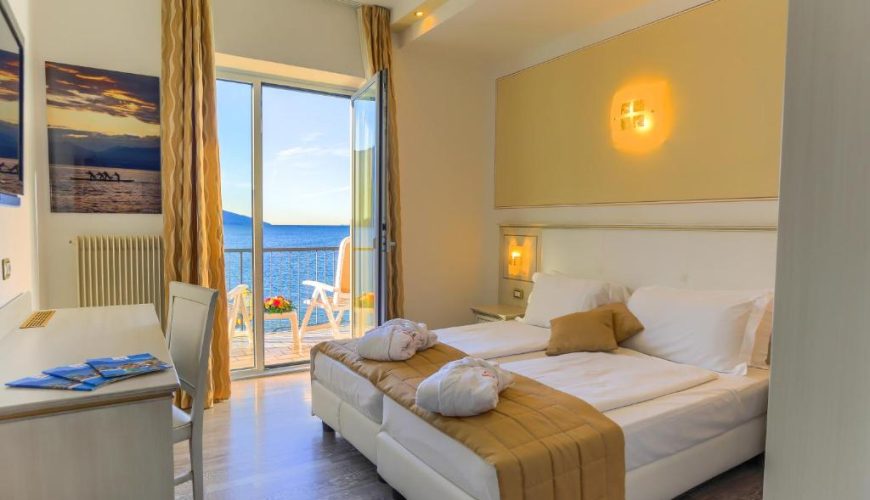
3-star hotels at Lake Garda offer good comfort at fair prices. Typical amenities: spacious rooms, often with balcony and lake view, breakfast buffet, pool, parking. Prices: €80-150 for a double room.
Many hotels specialize in athletes. They offer secure storage rooms for equipment, drying rooms for wetsuits, and know the best spots. Some have partnerships with surf schools and rental stations.
Popular addresses: Hotel Benaco in Riva, Hotel Lago di Garda in Torbole, Hotel Maximilian in Malcesine.
Luxury Hotels
For the discerning, Lake Garda also has first-class 4- and 5-star hotels. These offer wellness, gourmet restaurants, exclusive service, and often direct lake access. Prices: from €200 upward.
The Lido Palace in Riva is a luxury icon: historic building, large spa, several restaurants, directly on the lake. Du Lac et Du Parc in Riva and Villa Giulia Riva del Garda are also top hotels.
Vacation Apartments and Rentals
Vacation apartments are particularly attractive for longer stays and families. You have more space, a kitchen for self-catering, and often a balcony or terrace.
The selection is huge – from simple studios to luxury penthouse apartments. Platforms like Airbnb, Booking.com, and local agencies broker thousands of properties.
Prices: A simple apartment for 2-4 people costs about €60-120 per night, larger or more luxurious properties correspondingly more. With longer stays (2+ weeks), discounts are often possible.
What to watch for? Location is crucial! Without a car, the apartment should be within walking distance of spots and infrastructure. The parking question is also important – in Torbole and Riva these are scarce.
Surf Camps and Packages
For young surfers and solo travelers, surf camps are a great option. These packages combine accommodation, surf course, and often meals at an all-in price.
Typical services:
- 7 nights in shared rooms or bungalows
- Surf course (3-5 days)
- Equipment use
- Often half-board or full-board
- Activity program (BBQ, excursions, parties)
Prices: €400-800 per week, depending on season and services.
The atmosphere in surf camps is great: you quickly meet people, have shared experiences, and organization is uncomplicated. Perfect for young adults, students, or solo travelers.
Known providers: Surfcamp Torbole, Malcesine Surf Camp, Beachbreak Gardasee.
Getting to Lake Garda
Lake Garda is easily accessible from Germany, Austria, and Switzerland. Most surfers arrive by car, but travel by train or plane is also possible.
By Car
Traveling by car is the most flexible option. You can bring your own equipment (if available), have mobility on-site, and can stay as long as you like.
Route from Germany:
From Munich via the Brenner motorway A13/A22 it’s about 350 km, travel time approximately 4 hours. The route leads over the Brenner Pass to Italy and then on the A22 toward Trento/Bolzano. Shortly before Trento, take the exit toward Lake Garda.
From Stuttgart it’s about 550 km (5-6 hours), from Frankfurt about 750 km (7-8 hours). The route leads through Switzerland (Gotthard tunnel or San Bernardino Pass) or through Austria (Brenner).
Tolls and Vignettes:
In Austria, the motorway vignette is required (about €10 for 10 days, €27 for 2 months). The Brenner has additional tolls (about €11).
In Italy there are distance-based tolls on motorways. The Brenner motorway A22 costs about €8-15, depending on distance. Toll is paid at toll stations when exiting (cash or credit card).
Switzerland requires an annual vignette (about €40) if traveling via Swiss motorways.
Fuel Prices:
Refueling in Italy is more expensive than in Germany. If possible, fill up once more before the border. Motorway service stations are particularly expensive.
By Train
Train travel is more relaxing than driving and more environmentally friendly. From Munich there are direct trains to Rovereto or Trento (about 4-5 hours), from where you can continue by bus to Lake Garda.
From farther north (e.g., Frankfurt, Hamburg) you must change trains, travel time is 8-12 hours. Night trains are an option – you save a hotel night and arrive refreshed.
Local Connections:
Torbole and Riva are accessible by bus from Trento or Rovereto (about 30-60 minutes travel). Malcesine is connected via Verona. Bus connections are good, but those with lots of equipment must expect logistical effort.
On-site you can get around well by bus – these run along the lake and connect all towns. A car isn’t absolutely necessary but increases flexibility.
The nearest airports are Verona (about 80 km south of Lake Garda), Bergamo Orio al Serio (about 100 km west), and Brescia Montichiari (about 60 km south). From all airports there are bus connections or rental cars.
Verona Airport (VRN): The nearest major airport. Buses run directly to Lake Garda from here (e.g., ATV buses to Malcesine, Riva, Torbole). Travel time about 1-1.5 hours. Alternatively rental car or taxi.
Bergamo Airport (BGY): Often served by budget airlines (Ryanair etc.). Bus connections to Lake Garda available but with transfers. A rental car is practical here.
Brescia Airport (VBS): Small airport with few connections. Close to Lake Garda (south shore) but still 1.5 hours drive to Torbole/Riva.
Many surfers fly to Verona and rent a car there. This is convenient but rental cars in high season can be expensive (from €300/week).
Getting Around On-Site
Those arriving by car have maximum flexibility. You can visit different spots, do shopping, and make excursions.
However, parking is difficult. In Torbole and Riva, parking spaces are scarce and expensive (often €2-5/hour). Many accommodations have their own parking, but not all.
By Bicycle:
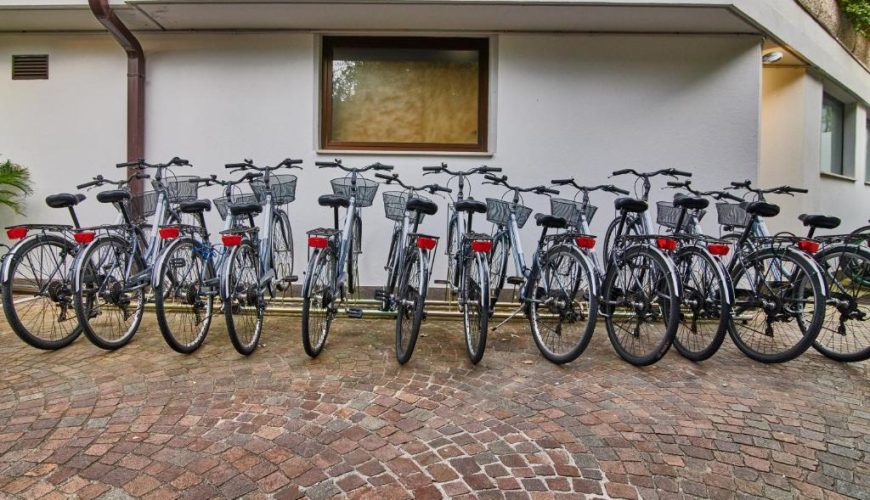
Bicycles are a popular means of transport at Lake Garda. Distances are manageable and there are good bike paths. From Torbole to Riva it’s about 3 km, to Malcesine about 15 km.
Many surfers rent e-bikes – even hilly routes are no problem with these. Rental stations are everywhere.
By Bus:
The public bus network around Lake Garda is well developed. Line 483/484 connects Riva, Torbole, Malcesine, and other towns. Buses run frequently but are often overcrowded in high season.
A day ticket costs about €5-8, a week pass €20-30. For surfers without a car, this is the best option.
Rules and Safety on the Water – What You Need to Know
Clear rules apply to windsurfers at Lake Garda that must absolutely be followed. These rules serve the safety of all water sports enthusiasts and are also enforced. Violations can result in fines.
Registration Requirement and Permits
Mandatory Registration
All windsurfers at Lake Garda must register. This registration requirement applies equally to Italians and foreigners. Registration is done with local authorities (Guardia Costiera) or – easier – directly through the surf school or rental station.
Registration is free and uncomplicated. You provide name, date of birth, nationality, and length of stay. As confirmation, you receive a number or sticker that should be visibly attached to the board.
Most surf schools and rental stations handle registration for their customers automatically. Those bringing their own equipment must take care of it themselves. Registration is possible at harbor offices in Torbole, Riva, and Malcesine.
Why This Requirement?
Registration serves safety. In emergencies, the coast guard knows who’s on the water. The number of windsurfers is also recorded for statistical purposes. The regulation has existed for many years and is consistently enforced.
Zones and Distance Rules
The 300-Meter Zone
One of the most important rules at Lake Garda is the 300-meter zone. This zone extends from shore 300 meters into the water and is marked by yellow buoys.
Within the 300-meter zone:
- Only beginners and surfers with sails up to 4.0 m² may sail
- Maximum speed: slow speed (about walking pace)
- No planing, no jumps, no fast maneuvers
- Consideration for swimmers and other water sports enthusiasts
Outside the 300-meter zone:
- Advanced surfers with larger sails sail here
- Planing and higher speeds allowed
- Still show consideration for other surfers
This rule makes sense: it protects swimmers and bathers near shore and gives beginners a protected area for learning. Advanced surfers have more space outside and can sail faster.
Distance to Boats and Ships
Motorboats, sailboats, and tour ships have right of way. Windsurfers must keep distance and give way. Especially the large passenger ships operating between towns should be passed with a large safety margin.
Windsurfing is prohibited in harbor entrances and boat corridors. These areas are clearly marked and must be widely circumnavigated.
Life Jackets and Safety Equipment
Life Jacket Requirement for Beginners
In Italy there’s a life jacket requirement for windsurfing beginners. A beginner is anyone who can’t yet tack and jibe safely or who’s at Lake Garda for the first time.
The life jacket must have buoyancy of at least 50 Newtons. Most surf schools automatically provide vests to course participants. Life jackets can also be rented at rental stations.
Recommendation for Advanced Surfers
Even though there’s no vest requirement for advanced surfers, wearing a vest or impact vest is recommended. Especially in strong wind, gusty conditions, or when alone, a vest greatly increases safety.
Modern impact vests are thin, lightweight, and barely restrictive. They provide buoyancy and simultaneously protect from bruising during falls.
Additional Safety Equipment
A leash (safety line) between surfer and board isn’t common at Lake Garda and is considered dangerous by many. During falls, the board could snap back and injure the surfer.
A waterproof emergency phone in a protective case makes sense. In case of problems, you can call for help. Many surfers also use waterproof smartwatch cases.
Weather Observation and Dangers
The Ora as Challenge
The Ora is reliable but not to be underestimated. It can set in very abruptly – within 20-30 minutes from calm to Force 6. Inexperienced surfers are surprised by this.
Those who have ventured too far from shore and are suddenly surprised by strong Ora can have problems. The sail that’s too large can no longer be controlled, you capsize constantly and can’t get back to shore.
How to Protect Yourself?
- Check wind forecast: Apps like Windfinder show when the Ora is coming
- Stay near shore while uncertain
- Choose appropriate sail size – better too small than too big
- At first signs of Ora (rising waves, stronger wind) sail toward shore
Katabatic Winds and Gusts
On the northern shore, especially between Torbole and Riva, there are katabatic winds from the mountains. These locally amplify the Ora and create gusty conditions. Wind strength can vary by 2-3 Beaufort within a few meters.
Beginners should avoid the northern shore with strong Ora and switch to calmer spots like Malcesine.
Thunderstorms
Summer thunderstorms can approach quickly at Lake Garda. Thunderstorms over water are dangerous – the mast acts like a lightning rod. At first signs of a thunderstorm (dark clouds, distant thunder), head immediately to shore.
Surf schools and rental stations monitor weather and issue warnings. When in doubt, better skip a session than put yourself in danger.
Right-of-Way Rules on the Water
Like in traffic, there are right-of-way rules on the water. Knowing and following these prevents collisions.
Basic Rule: Starboard Before Port
When two surfers cross, the one holding the sail on the right side (starboard) has right of way. The other must give way.
Overtakers Must Give Way
Whoever overtakes another surfer must give way and keep distance. The overtaken maintains course.
Windward Sailor Before Leeward Sailor
With oncoming surfers, the windward sailor (sailing against the wind) has right of way. The leeward sailor (with wind from behind) must give way.
Practical Tips:
In practice, rules aren’t always clear, especially with many surfers on the water. Caution and anticipatory sailing are more important than rigidly adhering to right-of-way rules.
When uncertain, better give way even if you theoretically have right of way. A collision hurts both parties.
Seek eye contact: When crossing another surfer, eye contact helps clarify who gives way.
Behavior in Emergencies
Self-Rescue
Every surfer should be able to free themselves from minor problem situations:
- Lost rig: Swim to rig, pull it onto board and paddle back
- Broken mast: Wrap sail around broken mast, lay everything on board and paddle back
- Fatigue: Lie on board, rest, paddle slowly back
When Help is Needed
With serious problems (injury, panic, onshore wind makes return impossible):
- Give signal: Arms crossed above head is the international distress signal
- Stay with equipment: Board and rig provide buoyancy
- Don’t try to swim to shore – distances are large
- Coast guard and surf schools monitor the water and will notice
Emergency Numbers:
- Emergency Italy: 112
- Coast Guard (Guardia Costiera): 1530
- Most surf schools also have their own emergency numbers
Respecting Environment and Nature
Lake Garda is a protected natural area. Surfers should respect the environment:
- Leave no trash – neither on beach nor in water
- Protect reed and shore areas – these are animal habitats
- No oil stains or chemicals in water
- Avoid noise, especially in early morning hours
Many surfers participate in beach clean-up actions or local environmental projects. Lake Garda is our playground – we should protect it.
Additional Activities at Lake Garda – When the Wind Takes a Break
Lake Garda offers far more than just windsurfing. On windless days or for variety, there are numerous alternatives that make a vacation at Lake Garda a complete experience. The region is a paradise for athletes and offers enough program even for non-surfers.
Mountain Biking – A Second Paradise
Lake Garda is considered one of Europe’s best mountain biking destinations. The combination of Mediterranean climate, spectacular landscape, and countless trails attracts bikers from around the world.
Trail Diversity for Every Level
From simple lakeside paths to demanding downhill routes, everything is available. Especially the northern shore and eastern mountains (Monte Baldo, Monte Altissimo) offer endless trails.
Beginners and leisure cyclists find beautiful, flat bike paths along the shore. The route from Torbole to Riva along the lakeshore is easy and scenically charming. The bike path along the Sarca River northward is also recommended.
Advanced bikers can do demanding tours. Popular is the tour from Riva via the Ponale Road to Ledro – an old military road with breathtaking views. The route is partly technical but well rideable for experienced bikers.
Downhillers and enduro riders find perfect conditions on Monte Baldo and Monte Altissimo. There are cable cars that bring bikers with bikes up the mountains. From there, demanding trails lead back to the valley. The Monte Baldo Bike Park offers marked routes of various difficulty levels.
Bike Rental and Tours
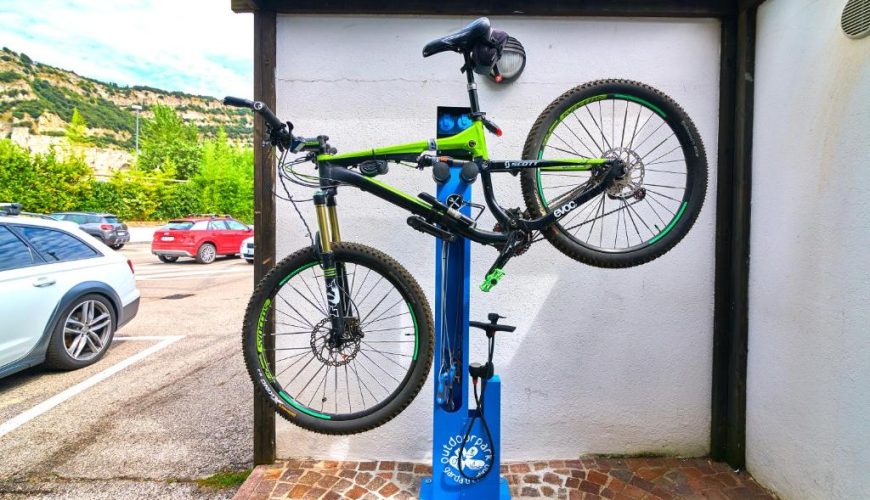
Bike rentals exist in all towns. Modern mountain bikes (hardtails and full suspension) cost about €30-50 per day, e-bikes €40-70. With longer rental periods there are discounts.
Many providers organize guided tours with local guides. This is particularly recommended for first-time visitors – guides know the best trails and current conditions.
Climbing in Arco – World-Class Level
Arco, a few kilometers north of Lake Garda, is one of the world’s most famous climbing destinations. The rock formation around Arco offers over 2,000 routes in all difficulty levels.
Sport Climbing for All Levels
Arco’s climbing gardens are perfectly developed. Routes from 3 to 9+ UIAA are available. The rocks are grippy limestone, protection is usually good.
Beginners find easy routes at low height with many holds. The Massone and Baone climbing gardens are particularly beginner-friendly. Advanced climbers can try steep slabs, overhangs, and technical routes.
Climbing Courses and Guided Tours
Numerous climbing schools in Arco offer courses for beginners and advanced climbers. You learn belay technique basics, various climbing techniques, and climb first routes under guidance.
Guided tours are also possible. A local guide takes you to the best spots, gives technique tips, and knows the routes.
Bouldering
Besides sport climbing, Arco is also a bouldering hotspot. The Padaro and Prabi boulder areas offer hundreds of problems on gneiss rock. Many world-class boulderers train here.
Hiking – Discovering the Mountains
The mountains around Lake Garda invite hiking. From relaxed walks to alpine summit tours, everything is possible.
Easy Hikes
For leisurely hikers there are many beautiful paths. The hike from Riva to Pregasina offers great views and can be done in 2-3 hours. The path is well marked and not too steep.
The hike to the pilgrimage church Madonna di Monte Castello near Tignale is also popular. The path leads through olive groves, the view from the church square is magnificent.
Challenging Mountain Tours
Ambitious hikers can climb peaks. Monte Baldo (2,218m) is the highest mountain on the eastern shore and can be hiked from Malcesine. Alternatively, take the cable car to 1,760m and hike from there to the summit.
Cima Rocca (1,976m) and Monte Altissimo (2,079m) on the western shore are also worthwhile destinations. These tours require stamina, sure-footedness, and alpine experience.
Via Ferrata – Climbing Routes
For the adventurous there are several via ferratas (climbing routes) in the region. The Via Ferrata dell’Amicizia near Riva is spectacular – it leads via ladders, iron rungs, and steel cables through steep rock faces. Via Ferrata Fausto Susatti on Monte Casale and Via Ferrata Cima Capi are other great climbing routes.
Prerequisites: no fear of heights, basic fitness, and proper equipment (via ferrata set, helmet). Beginners should book guided tours.
Water Sports Alternatives
Kitesurfing
Besides windsurfing, kitesurfing is also possible at Lake Garda, though only at certain spots and with restrictions. Campione on the western shore is the main kite spot. Conditions with Ora are excellent.
In Torbole and Riva, kitesurfing is officially prohibited – too crowded, too dangerous. Those wanting to kite must go to Campione or the southern shore.
Stand-Up Paddling (SUP)
SUP has become very popular at Lake Garda. The quiet morning hours with little wind are perfect for paddling. Many rental stations offer SUP boards (about €15-25/day).
SUP yoga, SUP tours at sunrise, or SUP fitness courses are organized by various providers.
Sailing
Lake Garda is a traditional sailing area. Numerous sailing schools offer courses, and those who can already sail can rent dinghies or catamarans. Wind conditions are similar to windsurfing – Peler in mornings, Ora in afternoons.
Kayak and Canoe
With kayaks you can explore remote bays and beaches. Tours along the cliff coast or to small islands are possible. Rental stations exist in all larger towns.
Sightseeing and Culture
Lake Garda has many beautiful towns that invite strolling:
Sirmione on the southern shore is a highlight: a peninsula with medieval castle (Castello Scaligero), narrow alleys, thermal springs, and Roman ruins (Grotte di Catullo). Sirmione is touristy but beautiful.
Limone sul Garda on the western shore was formerly a lemon village. The old lemon houses (Limonaie) can be visited. The town is picturesque, though very touristy.
Malcesine impresses with its medieval Scaliger Castle towering high above the town. The old town with narrow alleys and small squares is charming.
Riva del Garda has a Venetian-influenced old town with beautiful arcades, squares, and cafés. The Rocca (castle) houses a museum.
Castles and Palaces
Around Lake Garda there are numerous castles and palaces. The Scaliger castles (Castello Scaligero) in Malcesine, Torri del Benaco, and Sirmione are particularly worth seeing.
Museums
The MAG (Museo Alto Garda) in Riva shows art and history of the region. MUSA (Museum Salò) in Salò is dedicated to the history of “Repubblica Sociale Italiana.” In Arco there’s Arco Castle to visit.
Wellness and Relaxation
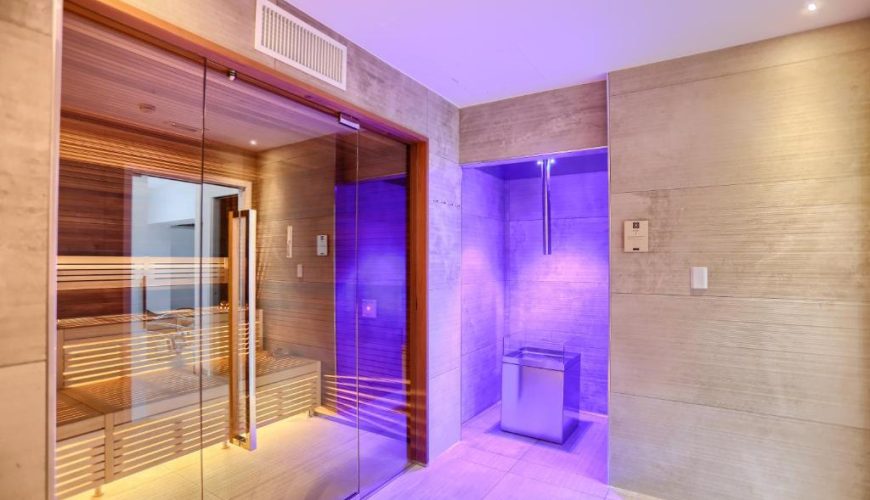
After strenuous surf sessions, relaxation feels good. Many hotels offer wellness areas with sauna, steam bath, and massages.
Thermal Springs
In Sirmione there are thermal springs with healing water. The thermal centers Aquaria and Terme di Sirmione offer thermal baths, spa treatments, and medical applications.
In Lazise and Colà (Colà Thermal Park) there are also thermal facilities with pools, saunas, and wellness offerings.
Culinary – Italian Joie de Vivre
Lake Garda is a culinary delight. The cuisine combines Italian and alpine influences.
Typical Dishes:
- Carne Salada (cured beef, a specialty from Trentino)
- Sarde al limone (sardines with lemon)
- Risotto with Lake Garda fish
- Strangolapreti (spinach-ricotta dumplings)
- Polenta in all variations
Olive Oil and Wine
High-quality olive oil is produced at Lake Garda. Europe’s northernmost olive groves are located here. Many oil mills offer tastings.
Wine is also excellent. Bardolino, Valpolicella, and Lugana are well-known growing regions. Wineries offer wine tastings and tours.
Restaurants and Trattorias
From simple pizzerias to gourmet restaurants, everything is available. Particularly recommended are small, family-run trattorias away from tourist crowds – here you get authentic cuisine at fair prices.
Excursions to the Surrounding Area
The city of Romeo and Juliet is only 50 km from Lake Garda and makes a worthwhile day trip. The Arena di Verona (Roman amphitheater), Piazza delle Erbe, and many historic churches and palaces make Verona a highlight.
The capital of Trentino lies north of Lake Garda. The old town with the cathedral, Castello del Buonconsiglio, and Renaissance palaces is worth seeing. The MUSE (Science Museum) is also worth a visit.
Venice is about 150 km away – a bit far for a day trip but perfect for a two-day excursion. The lagoon city is unique and should be planned during a longer stay at Lake Garda.
The Dolomites lie north of Lake Garda and are reachable in 1-2 hours. The spectacular mountains offer hiking, climbing tours, and breathtaking landscapes.
Costs and Budget – What Does a Windsurfing Vacation at Lake Garda Cost?
An important aspect of planning is the budget. Costs can vary greatly depending on travel style, season, and requirements. Here’s an overview of expected expenses.
Budget Variant (Low-Budget)
With about €50-80 per day, a frugal traveler can get by:
- Camping: €15-25 per person/night
- Food: €20-30 (self-catering, occasional eating out)
- Equipment rental: €25-40/day (or own equipment)
- Miscellaneous: €5-10 (small items)
For a week that’s about €350-560, excluding travel.
Mid-Range Variant
With €100-150 per day you have significantly more comfort:
- Hotel/vacation apartment: €40-70 per person/night
- Food: €35-50 (mix of self-catering and restaurant)
- Equipment rental: €30-50/day
- Activities: €10-20 (excursions, entrance fees)
- Miscellaneous: €10-15
Weekly costs: €700-1050, excluding travel.
Comfort Variant
Those who can afford it spend €200+ per day:
- Good hotel: €80-150 per person/night
- Dining at upscale restaurants: €60-100
- Private instruction/premium rental: €50-100
- Wellness and extras: €20-40
Weekly costs: €1400+, excluding travel.
Money-Saving Tips
- Travel in shoulder season (April/May or September/October)
- Camping instead of hotel
- Self-catering instead of restaurant
- Longer rental periods for equipment (week passes are cheaper)
- Bring own equipment (with regular visits)
- Use early bird discounts
Community and Scene – The Lifestyle at Lake Garda
Lake Garda is more than just a windsurfing spot – it’s a community. The surf scene here is international, relaxed, and passionate.
The International Surf Family
At Lake Garda you meet surfers from all over Europe: Germans, Austrians, Swiss, Italians, Dutch, British, and many more. The shared passion for windsurfing connects.
On the water, everyone’s on first-name terms, helping each other and exchanging tips. After sessions, people gather in beach bars, talk about the best runs of the day, and plan the next session.
Regulars and Locals
Many surfers have been coming to Lake Garda for years or decades. They have their regular spots, favorite places, and know every corner. These regulars form a tight-knit community.
The local surfers are also part of the scene. They’ve been surfing here since childhood, know every gust and every wind. You can learn a lot from them.
Events and Competitions
Windsurfing events and competitions regularly take place at Lake Garda. The Renzo Rosso Trofeo in Campione and the Torbole Cup are traditional events attracting participants from across Europe.
Unofficial GPS speed sessions are also popular. Surfers measure their speed with GPS devices and compare top speeds. Results are published in apps like GP3S.
Insider Tips – What Locals Know
Here are some insider tips you won’t find in every travel guide:
Timing is everything: The best surfers are on the water mornings with Peler and afternoons with Ora. Those who only do one session miss half the fun.
Campione with strong Ora: When Force 7 is forecast in Torbole, Campione is the better spot. The venturi effect provides consistent power without Torbole’s extreme gusts.
Monday is rest day: Many surf schools and rental stations have Mondays off or reduced hours. Monday is therefore quieter – ideal for those avoiding crowds.
Watch wind statistics: Statistically, July and August are the windiest months. But with flexibility, you often find even better conditions in June and September with less hustle.
Buy local products: At weekly markets (e.g., Riva Wednesdays, Arco Saturdays) you get fresh fruit, vegetables, cheese, and sausage at fair prices. This saves budget and tastes better than supermarket goods.
Lakeside paths when calm: When windless, a walk or bike ride on lakeside paths is worthwhile. The views are magnificent, and you discover hidden bays and beaches.
Frequently Asked Questions (FAQ)
Can I learn windsurfing at Lake Garda as a beginner?
Yes, Lake Garda is ideal for beginners! Especially the eastern shore (Malcesine) offers perfect learning conditions. Professional surf schools get everyone on the water. Torbole is also suitable for beginners if you surf mornings with the gentle Peler.
Do I need my own equipment or can I rent everything on-site?
You can rent everything on-site. Rental stations are excellently equipped, equipment is modern, and prices fair. Own equipment only pays off if you come regularly.
When is the best time for windsurfing at Lake Garda?
High season (July/August) offers the strongest and most reliable winds. June and September are also excellent and less crowded. May and October work well too, with slightly more weather risk.
How strong is the Ora really?
The Ora typically reaches Force 4-6 on the Beaufort scale, on peak days even Force 7. That corresponds to about 15-35 knots. Perfect for experienced surfers, challenging for beginners at full strength.
Is Lake Garda overcrowded in summer?
Yes, main spots (Torbole, Riva) are very crowded in July/August. On the water, 200+ surfers can gather. Those seeking peace should switch to less known spots or come in shoulder season.
Do I need a car at Lake Garda?
Not necessarily. Buses connect all towns well. With a car, however, you’re more flexible, can visit different spots, and transport shopping more easily.
What’s the water like at Lake Garda?
The water is clean and clear. Visibility is often several meters. Water temperature in summer is 24-26°C (75-79°F), in spring/autumn 15-22°C (59-72°F).
Are there sharks or dangerous animals in Lake Garda?
No, Lake Garda is a freshwater lake without dangerous animals. There are fish (trout, pike, carp) but no danger to surfers.
Can I also surf in winter?
In winter (November-March) the thermal system barely functions. Only on a few days with strong sun and high pressure does a weak Ora develop. Most surf schools and rental stations are closed. For normal windsurfing vacations, winter isn’t suitable.
How do I get from the airport to Lake Garda?
From Verona Airport, buses run directly to towns at Lake Garda (1-1.5 hours). Alternatively rental car or taxi. From Bergamo Airport you need one or two transfers or a rental car.
Conclusion: Lake Garda is a Windsurfing Dream
Lake Garda combines everything windsurfers cherish and love: reliable winds that function with the precision of Swiss clockwork; excellent infrastructure with professional surf schools, top-equipped rental stations, and the latest equipment; Mediterranean flair with Italian lifestyle, excellent cuisine, and relaxed atmosphere; as well as a vibrant, international surf community that lives and loves the sport.
Something for Everyone
Whether beginner or pro, at Lake Garda everyone finds their perfect spot and ideal conditions. Beginners learn first steps on calm water in Malcesine, while pros test their limits in Torbole with strong Ora. The diversity of spots, from gentle to extreme, makes Lake Garda so unique.
More Than Just Windsurfing
The combination of athletic challenge, nature experience, and Italian lifestyle makes Lake Garda one of the world’s most beautiful windsurfing destinations. And when the wind takes a break, mountain biking, climbing, hiking, and culture offer enough program for weeks.
The Magic of Lake Garda
Once you’ve felt the Ora filling the sails and catapulting the board across the water; once you’ve glided across the lake at sunset with the Italian Alps as backdrop; once you’ve experienced the special atmosphere in Torbole when hundreds of surfers pursue their passion together – you’ll definitely come back.
Lake Garda isn’t simply a vacation destination. It’s a lifestyle, a passion, a second home for many windsurfers. The combination of sport, nature, culture, and community is unique and makes every stay a special experience.
Europe’s Perfect Windsurfing Spot
Many surfers have traveled the world, surfed in Hawaii, Tarifa, Essaouira, and countless other spots. And yet they always return to Lake Garda. Why? Because nowhere else in Europe are conditions so reliable, infrastructure so good, landscape so beautiful, and atmosphere so special as here.
Lake Garda is more than a windsurfing spot – it’s the heart of the European windsurfing scene. A place where dreams come true on the water, lifelong friendships form, and unforgettable moments are experienced.
Time for Your Lake Garda Adventure
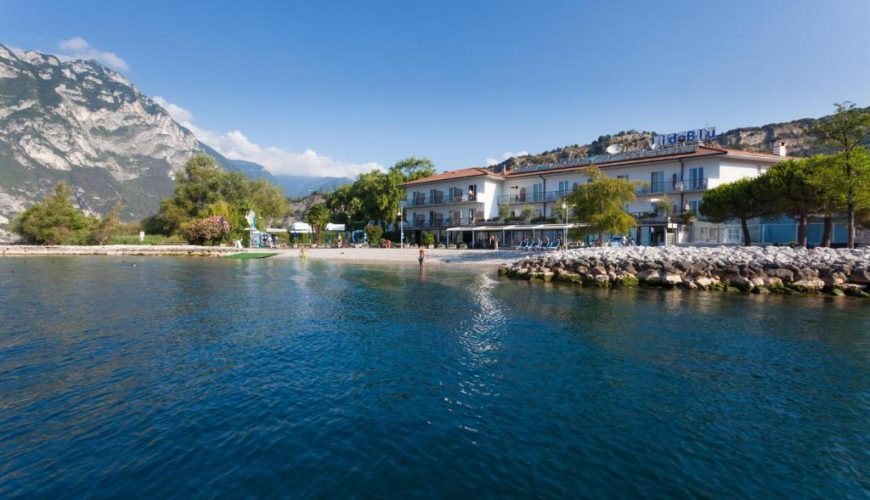
What are you waiting for? Pack your things (or don’t – you can rent everything on-site), book your accommodation, and experience for yourself why Lake Garda has been magically attracting surfers from around the world for decades. Hotel Lido Blu
Whether you’re stepping on a board for the first time or have already spent thousands of hours on the water – Lake Garda will thrill you. The Ora awaits you, the waves are calling, and the adventure begins the moment you arrive at the northern shore and feel the wind in your face.
See you at Lake Garda – arrivederci e buon vento (goodbye and good wind)!

Comment (0)